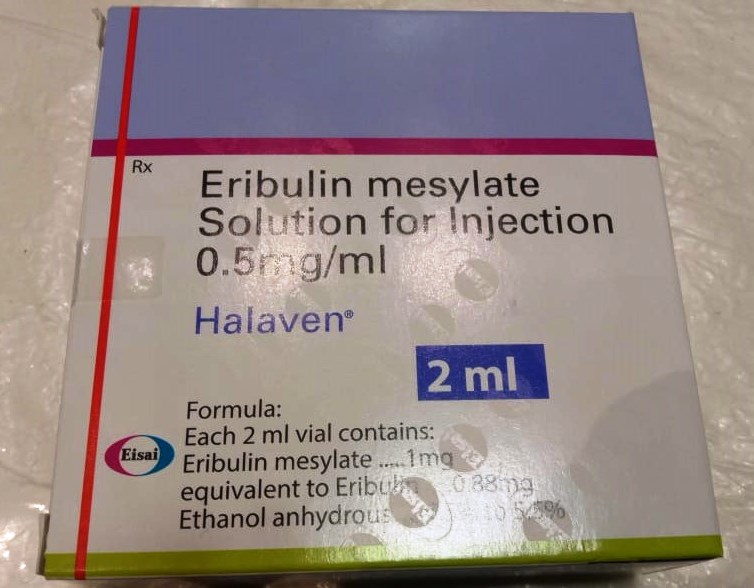
Halaven
Eribulin 0.5mg per ml Injection
Details
Purpose
Eribulin 0.5mg per ml injection is used for the treatment of metastatic breast cancer. the medication comes under the brand name halaven. The injection is commonly used for cancer patients who have undergone prior treatment of cancer including the drugs anthracycline and taxane.
How does it work?
Eribulin0.5mg per ml injection contains a microtubule dynamic inhibitor and eribulin mesylate. This all binds with the cancer cells and hence stops their further growth.
Measures and precautions
- Halaven injection is a prescribed medicine that is used for the treatment of breast cancer and metastatic liposarcoma who have prior treatment with anthracycline and taxane.
- The recommended dose of halaven injection is 1.4mg/m2.
- The Eribulin0.5mg per ml injection is administered to the body intravenously. No other method should be entertained for administered.
- The administration should be done over 2 to 5 minutes on days 1 and 8 of a 21-a day cycle.
- The dosages depend on the medical conditions of the patients. There should be a close monitor of the patient before administering the drug.
- It is recommended to take the Eribulin 0.5mg per ml injection with the dextrose solution as an adjunct.
- Avoid administration in the same intravenous line as other medicinal products have done.
- Do not increase or decrease the dose of halaven injection by yourself without a doctor’s consultation. This would harm your body.
- Monitor closely the blood counts of the patients before and after consumption of injection.
- Don’t use the discarded vials of the injection as they are unfit for use.
- Do not try to overdose on this injection, it has fatal effects on the host body.
Side-effects
- Fatigue/ asthenia
- Anemia
- Nausea
- Alopecia
- Constipation
- Neutropenia
- Peripheral neuropathy
- Febrile neutropenia
- Musculoskeletal pains
- Pyrexia
- Diarrhea
- Loss in weight
- Cough
Interactions
No drug interaction reactions are seen with CYP3A4 inducers and P-glycoprotein inhibitors. But some changes are seen with exposure of AUC which doesn’t get observed in the patient’s body. when this injection is administered with rifamycin, some changes are observed. The eribulin drug does not inhibit the action of CYP2C9, CYP1A2, CYP2C19, CYP3A4 enzymes at any level. It also doesn’t alter the plasma concentrations of drugs of other types of drugs.
Storage
Store the vial of the injection at a cool place at normal temperature. before use, the medicine should be kept for up to 4 hours at room temperature under the refrigerator.
Frequently Asked Questions
1. What is Halaven?
Halaven is an anti-cancer medicine containing eribulin mesylate, a microtubule inhibitor. Lotus International lists Halaven as Eribulin 0.5 mg/mL Injection for oncology use. It is administered intravenously under the supervision of qualified healthcare professionals.
2. What is Halaven used for?
Halaven is used for certain patients with metastatic breast cancer who have previously received specified chemotherapy regimens, including an anthracycline and a taxane. It is also indicated for unresectable or metastatic liposarcoma after prior anthracycline-containing treatment, subject to applicable prescribing information.
3. How does Halaven work?
Eribulin works by inhibiting microtubule dynamics, which interferes with the processes cancer cells require for cell division. This mechanism can help inhibit the growth and multiplication of cancer cells.
4. How is Halaven administered?
Halaven is administered by intravenous injection by a qualified healthcare professional. The approved regimen commonly uses 1.4 mg/m² administered over 2–5 minutes on Days 1 and 8 of a 21-day cycle, with dose modifications required in certain patients. Treatment should always follow the prescribing oncologist’s instructions.
5. What are the possible side effects of Halaven?
Possible adverse effects include neutropenia, anemia, fatigue, hair loss, nausea, constipation and peripheral neuropathy. Fever associated with low white blood cell counts can also occur. Patients receiving Halaven require appropriate clinical and blood-count monitoring.